Research
Toxoplasma–host interactions, gene by gene
We combine genome-wide Toxoplasma CRISPR screens, run in cell culture and directly in animals, with molecular parasitology, immunology, biochemistry and live-cell imaging, to learn how the parasite’s secreted effectors remodel the host cell and how the host fights back.
Toxoplasma gondii infects roughly one third of people worldwide and nearly every warm-blooded animal. Most infections are silent, yet the parasite can cause devastating disease in the developing fetus, in immunocompromised people and in the eye. We want to understand, gene by gene, how Toxoplasma establishes itself inside a host cell and spreads through the body, and why some hosts and some parasite strains produce very different outcomes.
Toxoplasma CRISPR screens
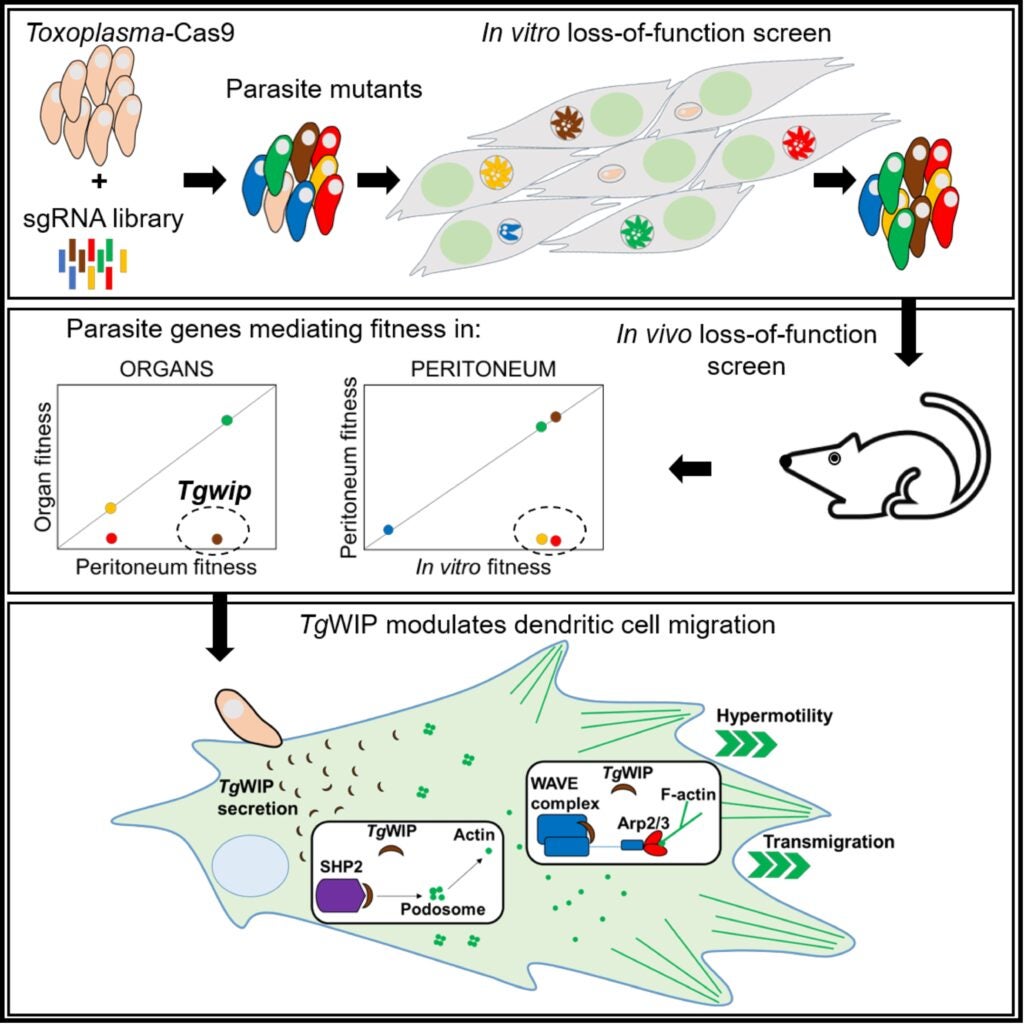
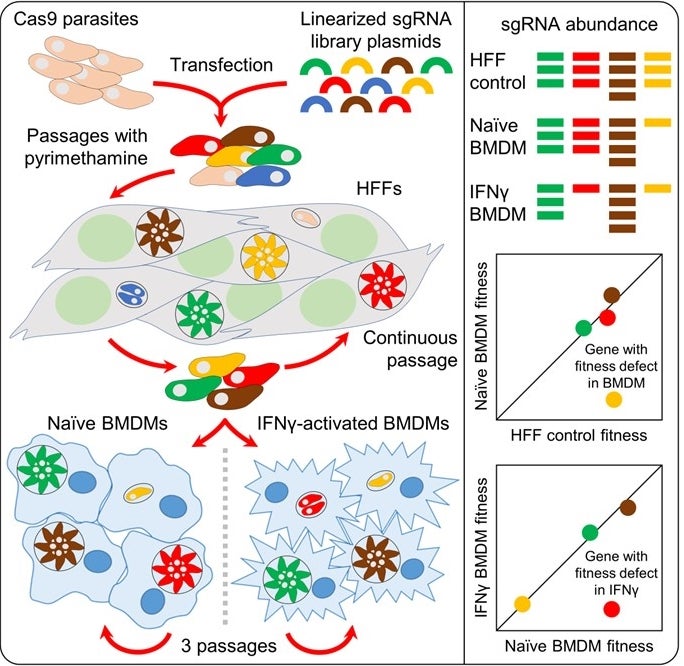
Genome-wide CRISPR/Cas9 loss-of-function screens in Toxoplasma let us ask which of the parasite’s roughly 8,000 genes matter in a given setting: in human fibroblasts, in naive or interferon-γ-activated mouse and human macrophages, in lipid-rich versus lipid-poor medium, in parasites that already lack a key gene (synthetic lethality), and directly in mice, where fitness in the peritoneum is compared with fitness in distant organs.
The screens tell us which parasite genes matter. The follow-up work, in cells, in mice and rats, and with purified proteins, tells us how.
Toxoplasma effectors and dissemination
To cause systemic infection, Toxoplasma must cross biological barriers, disseminate to distant organs including the brain, and avoid innate immune clearance. It does so largely through secreted Toxoplasma effectors: the rhoptry proteins (ROPs) injected during invasion and the dense granule proteins (GRAs) released into and beyond the parasitophorous vacuole. Using CRISPR screens performed in vivo we map the parasite genes required for fitness in the peritoneum and in organs.
One of them, TgWIP, is secreted into dendritic cells, where it reprograms actin dynamics and motility through the phosphatase SHP2 and the WAVE and Arp2/3 complexes, work done together with Antonio Barragan’s group at Stockholm University. Related effectors, including GRA28, give infected macrophages dendritic-cell-like hypermigration.
Immune evasion: surviving interferon-γ
Interferon-γ is the central mediator of resistance to Toxoplasma, and macrophages are frontline defenders. A genome-wide screen in naive and IFNγ-activated mouse macrophages identified about 500 parasite genes that affect fitness. GRA45, for example, keeps other effectors from aggregating before secretion; parasites lacking it are hypersensitive to IFNγ and attenuated in mice.
Human cells restrict the parasite differently. ROP5 and ROP18, essential for virulence in mice, are dispensable in human cells, so we screen directly in IFNγ-stimulated human fibroblasts and macrophages. These screens identified the GRA70 complex, a set of dense granule proteins the parasite needs specifically in IFNγ-stimulated human cells, and showed that the host E3 ubiquitin ligase ITCH links the effector GRA35 to NLRP1 inflammasome activation. We also study how human immune cells first recognize the parasite, including the early IFNγ response mounted by Vγ9Vδ2 T cells.
Life inside the parasitophorous vacuole
The parasite replicates inside a parasitophorous vacuole that separates it from the host cytosol, so everything it eats must cross the vacuole membrane. Dense granule proteins GRA17 and GRA23 form the pores that let small molecules diffuse in; GRA47 and GRA72 tune that permeability, and synthetic-lethality screens in parasites lacking GRA17 reveal the back-up routes. More recently we found GRA38, a regulator of parasite lipid homeostasis, and TgSEC14-LTP1, a SEC14-like lipid-transfer protein secreted into the vacuole.
Host and parasite genetics of toxoplasmosis
Toxoplasma strains differ enormously in virulence. Profiling macrophages infected with 29 diverse strains showed how strain-specific effectors such as ROP16 and GRA15 steer STAT3/6 and NF-κB signaling, and with it inflammation. On the host side, macrophages from resistant rat strains die rapidly through the NLRP1 inflammasome upon infection, denying the parasite a niche, whereas mouse macrophages activate inflammasomes without dying.
The same questions reach beyond the laboratory mouse: the strains behind ocular disease in South America, the proteins that let oocysts survive in the environment, and, in a collaboration led by Karen Shapiro’s lab at UC Davis that grew out of our peptide-based serotyping work, the Toxoplasma strains that kill southern sea otters off the California coast.
Funding
Current awards
- Mechanisms of host leukocyte-mediated Toxoplasma dissemination in its host
- Restriction of Toxoplasma growth in human cells
- Comparative Medical Science Training Program
Completed awards
- Toxoplasma sporozoite genes that determine environmental resistance and invasion of host cells.
- Genetic barcoding to track Toxoplasma cyst heterogeneity during brain colonization, reactivation, and drug treatment.
- Synthetic lethality screens in a nutrient sensitized Toxoplasma strain to identify novel proteins that mediate nutrient acquisition in chronic Toxoplasma infection.
- Genome-wide CRISPR/Cas9-mediated loss-of-function screens to identify Toxoplasma genes that determine fitness in gamma interferon-stimulated human cells
- Identification of Toxoplasma genes that mediate its colonization of the eye
- Identify Toxoplasma genes that determine in vivo fitness with CRISPR-Cas9 genetic screens
- Identification of the mechanism by which Toxoplasma activates the NLRP1 inflammasome
- Regulatory factors that determine Toxoplasma bradyzoite to merozoites conversion.
- Toxoplasma proteins that modulate the host cell
- A serological test to determine strains associated with occular toxoplasmosis
- Inhibiting Toxoplasma growth by disrupting its access to host small molecules
- Genetic Analysis of Innate Immunity to Infection
In the press
- MIT News, 2015 · New target for anti-malaria drugs
- UC Merced Newsroom, 2015 · Research shows increased risk of toxoplasmosis
- MIT News, 2013 · Biologists find clues to a parasite’s inconsistency
- ASM Microbe magazine, 2013 · Co-evolving host–pathogen molecular pairings determine host range (PDF)
- Infection and Immunity, 2013 · Editors’ spotlight: articles of significant interest
- MIT News, 2011 · Biologists shed light on a puzzling parasite
- Cell Host & Microbe, 2011 · Preview: Macrophages as a battleground for Toxoplasma pathogenesis
- Nature Reviews Microbiology, 2011 · Research highlight: It takes II to induce NF-κB
- MIT News, 2010 · On the trail of a stealthy parasite
- Nature Immunology, 2007 · Research highlight on the polymorphic ROP kinases
- Nature Reviews Microbiology, 2007 · Research highlight: Toxo researchers spot the difference